A one-year warranty on the CTO, and the mythology Purple Quarter built behind it.
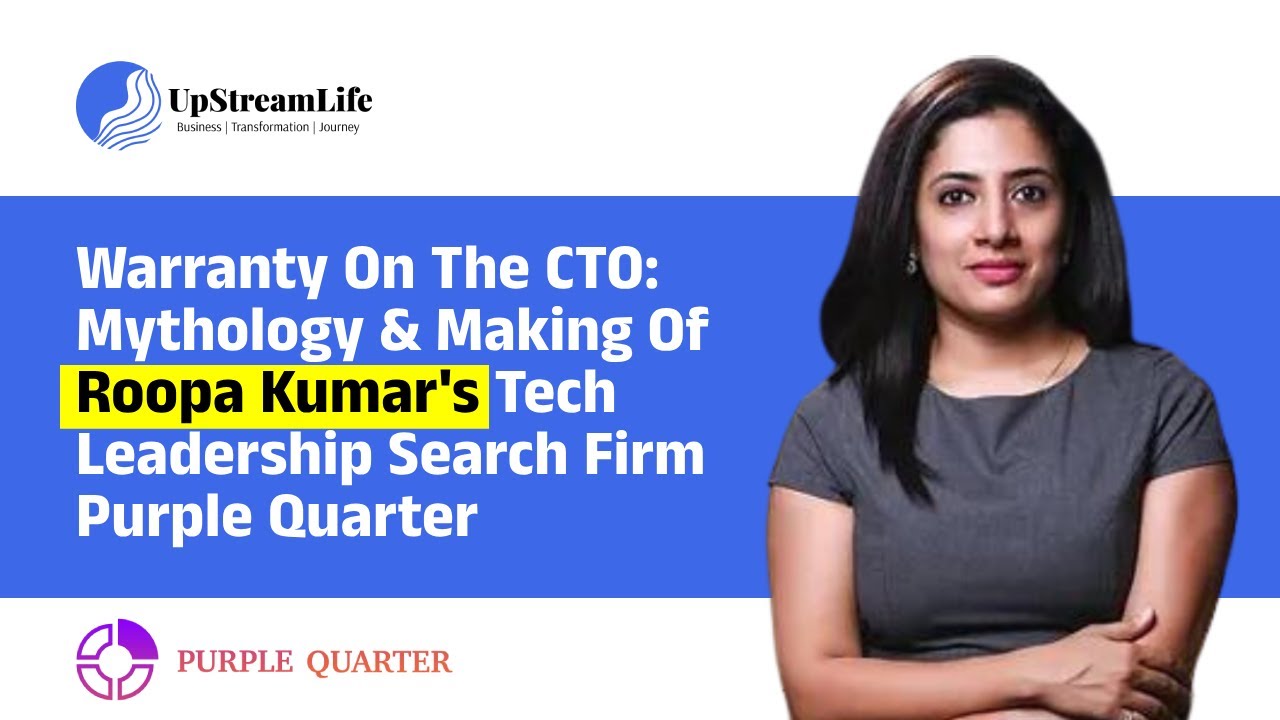
Most search firms get paid when the offer is signed. Roopa Kumar's gets paid when the marriage holds. Purple Quarter is the bespoke CTO-search outfit she and Deepak Sharma built after a 200-leader case study revealed why imported US technologists kept divorcing Indian startups inside a year. The fix was a 83-parameter, 200-question, four-meeting assessment per candidate, an industry-first replacement guarantee, and a Brahma-Vishnu-Shiva framework that sorts technology leaders by company stage rather than by resume. This conversation is what assessment-grade hiring looks like when you refuse the placement fee on a search that did not close.
In sixty seconds.
India's startup decade imported its first generation of CTOs from the United States, and many of those marriages dissolved inside a year. Roopa Kumar and Deepak Sharma read the casualty list, ran a two-hundred-leader case study, and concluded that the search-industry default of ten parameters is too coarse to predict whether a technology leader will stay. Purple Quarter's bet is that the assessment, not the rolodex, is the product.
That bet has three operating consequences. Eighty-three parameters across four meetings and roughly two hundred questions per candidate. A one-year replacement warranty that no Indian search firm had previously offered. And a mythology overlay that sorts technology leaders by company stage rather than by job title: Brahma for the zero-to-one creator, Vishnu for the million-to-billion nurturer, Shiva for the billion-to-multi-billion reconstructor. The firm will refuse the retainer if the placement does not close.
The conversation is also a portrait of what the search business looks like when the founder refuses the lazy version. CTPO versus CPTO is a letter-order question with a real chain of command behind it. A twenty-person stealth-mode startup does not need a CTO; it needs an engineering manager. A non-tech CEO doing the product job is, in Roopa's phrasing, building for a disaster. The whole apparatus exists because the cost of getting the senior tech hire wrong is the next eighteen months of the company.
Where to land in the conversation.
Each chapter opens the YouTube video at that timestamp in a new tab.
A decade of Indian tech-leadership hiring, briefly.
The arc Roopa sketches, lined up with the landmark events that frame the conversation.
Six ideas to carry into your own hiring.
Mental models lifted from the conversation that travel beyond executive search. Each one is the kind of thing you can quote in a hiring committee on Tuesday.
Brahma, Vishnu, Shiva.
Deepak Sharma's framing. Brahma is the creator-technologist for a company moving from product idea to product-market fit; the narrator who can also bring talent. Vishnu is the nurturer for the company crossing from a million dollars to a billion, the one who supervises the monolith-to-microservices migration on B2C, the integration story on B2B. Shiva is the reconstructor for billion-dollar companies that need someone to start new product lines and shut down failing ones. One job title, three different humans.
The 83-parameter, four-meeting protocol.
Roopa's predecessors in search ran with ten parameters. After the post-mortem on the early US-to-India CTO failures, Purple Quarter interviewed two hundred technology leaders and codified the assessment to eighty-three parameters covering culture, ambition, family relocation, mindset cycle, product instincts and seven other axes, asked across roughly two hundred questions over four meetings per candidate. The protocol is the moat. Filling a role without it is the lazy version of the same business.
The one-year warranty.
If the placed CTO is fired or leaves within twelve months, Purple Quarter replaces the person at no cost. Roopa frames it as a willingness to put their neck on the line because the assessment they have just run gives them statistical confidence. The warranty is more than a marketing point; it is the discipline that prevents the firm from closing searches the assessment said not to close.
The title-order test: CTPO versus CPTO.
Roopa decodes a small but load-bearing distinction. CTPO puts technology before product in the title, meaning a technology leader who carries the product mandate. CPTO inverts the order, declaring product the senior discipline. The choice is not branding; it is org-chart geometry. In Roopa's reading, India barely has a CPO class because the local CEOs still do product visualisation themselves. So CTPO is usually the truthful title; CPTO is usually an inflated one.
The do-you-actually-need-a-CTO test.
Twenty engineers and a stealth-mode product does not warrant a CTO; it warrants an engineering manager, sometimes a VP, sometimes a director. Roopa walks several founder conversations back to that line every year. The conversation Purple Quarter declines is the one where the founder wants a brand-name CTO before the business is ready to keep one. Roopa positions this as the firm's most expensive form of integrity, because saying no is saying no to a retainer.
Mentor for questions, coach for offloading.
Roopa keeps a small bench of mentors (Deepak, Abhishek Goel on the board, Amar Nagaram, Dale, and others she names in the conversation) whom she goes to with specific questions and gets specific answers. The coach is for the other half: market turbulence, fundraise stress, the dark side a mentor cannot host. The coach grounds. The mentor decides. Founders who fuse the two roles tend to under-use both.
Fifteen things to actually walk away with.
Each one carries the timestamps where the moment lives, and a transferable note for any senior hire, not only the CTO.
The narrative came before the placements. So did the first failures.
Roopa is unsentimental about how Purple Quarter began. She and Deepak Sharma spent six months selling a story about US-based Indian-origin technology leaders coming home to Indian startups ("capitalising on it completely, though we hadn't placed them") before the wave broke and a handful of those CTOs left their new companies inside a year. The narrative she had been selling boomeranged. The candidates she had spent months courting came back with the same question: is India even ready for tech talent.
What she did next is the part of the story most search firms would have edited out. Purple Quarter ran a case study on why the placements that happened around them had failed. The honest reading is what became the eighty-three parameters: mindset-adoption gaps, families that did not move with the leader, three-year mental contracts mistaken for one-year ones. The product is the post-mortem.
Two subtle points hidden inside the early CTO divorces.
The case study surfaced two findings that other search firms had missed. First, the US-based candidates were coming from very large, slow-cycle organisations into Indian startups whose pace required a two-year mindset transition; many had jumped in expecting a one-year transition and treated the role like a short stint. Second, the families did not move. The candidate was here on a strategic three-year assignment but living on Bengaluru-Bay Area flight schedules.
Both findings are operational, not psychological. A search firm with a ten-parameter intake screens for skills, not for marriage. Purple Quarter rebuilt the intake around those two signals, mindset coach-window and family relocation, then added eighty-one more. The two points are why the assessment is four meetings deep, not one.
William of Tokopedia and the ten-year question.
The trip that crystallised the firm's positioning was a visit Roopa and Deepak took to Tokopedia in Indonesia. The founder, William Tanuwijaya, told them a line that stuck: "you meet me ten years from now, I'll still be doing e-commerce." Roopa heard it as a permission slip. Purple Quarter could pick one job, technology leadership search, and dig in for decade-scale depth rather than spreading across functions. The eighty-three parameters were the operational consequence of that choice.
The Tokopedia visit is also why Roopa names credibility and reputation in the same breath as protocol. Decade-scale firms cannot afford to be transactional; the reputational cost of one bad placement compounds over years. The choice to be narrow turned out to be the choice to be patient with the same set of founders, candidates and post-placement signals over time.
The warranty is the discipline, not the marketing.
"We are the first search firm in India to come out with a one-year warranty," Roopa says. If the placed CTO is fired or quits within twelve months, Purple Quarter replaces the candidate without charging. The visible part of the warranty is the founder-friendly insurance. The invisible part is what it does inside the firm. A warranty changes the incentive arithmetic of every search the firm accepts. Refusing the warranty would mean refusing the discipline.
Roopa says it bluntly: if a founder wants to change CTOs as a control mechanism, "you have a problem there. The reason is then you can't do your warranty." The warranty is also the firm's exit door from a search that the assessment said should not close. The retainer goes back. The integrity stays.
The Brahma-Vishnu-Shiva stack is a stage classifier disguised as mythology.
Deepak's frame, three stages with one technology question each. Brahma is the creator-builder for a pre-PMF company moving toward a million-dollar revenue line; the technologist who can build the first product, narrate it externally and recruit the first ten engineers. Vishnu is the nurturer for a million-to-billion company; the engineering executive who supervises the monolith-to-microservices migration on B2C, the integration platform on B2B, and the doubling of the team without doubling the headcount problem.
Shiva is the reconstructor for a billion-dollar company that needs someone to open new product lines and close the ones that are not working. Roopa is careful with the word "destroy" and edits in real time to "destroy and recreate." The Shiva move is conscious unbundling, not vandalism. Same job title, three different humans, three different searches. The reason the mythology took hold across the search industry is that it reads more humanely than "stage classifier" while doing exactly that work.
"Search is a fast-food industry." Past glory does not pay rent.
The Swiggy placement was Purple Quarter's first calling card and, by Roopa's own admission, the first temptation to bask. She did. For a stretch she calls "arrogant Roopa," celebration crowded out execution and the company's financials reflected it. The lesson she takes from that quarter is the line she now teaches the team: search is a fast-food industry. The breakfast is forgotten before lunch. Once a role closes, the buyer's attention moves to the next role. The firm has to move with it.
The cultural consequence inside the team is that closing a search is a one-hour event. The team is wired to be quick at moving on. Roopa likens it to a journalist who cannot dwell on a story past two hours before having to find the next best one. The same instinct keeps Purple Quarter from over-investing in a single relationship.
2018 was a year on the floor, and it changed the founder's diet.
Roopa says it plainly. Twenty-eighteen was the year a founder she calls "arrogant Roopa" got sick. A bad year physically, partly the consequence of the firm having drifted into what she calls the "shark side." She turned vegan first, which she now ascribes most of the recovery to, and then began the slower work of nutrition and an under-construction meditation practice. The framing is unsentimental. She has not yet meditated for five minutes; her coach has been asking. She names the gap rather than pretending it is solved.
The deeper point she makes is that the founder's body is the only honest leading indicator of the firm's stress. Financials lag by quarters. Health lags by months but quietly. The vegan switch and the coach hire were the visible decisions; the invisible one was treating physical breakdown as a signal about how the firm was being run, not as bad luck.
Why India barely has a CPO class, and what that means for the CTO.
Roopa's read of the Indian product profession is harder than the founder cohort usually admits. She says she has not seen any India-built product climb the global charts in a way that produces a CPO with category authority. The Indian CEOs of her clients still do the product-visualisation work themselves. That leaves the technology leader carrying a portion of the product mandate the CTO in a US peer would not be expected to carry. CTPO is therefore the truthful title in many Indian companies; a CPO is too often an inflated one.
This is the structural reason her assessment digs as deep as it does into product instincts on a technology search. Hiring a CTO in India in 2023, in her telling, is hiring an executive who will sometimes also visualise the product, sometimes also build the engineering team, sometimes also fight the procurement battle. Buyers who try to break those into three hires usually do not have the cash, the rounds, or the brand for it.
Five-million USD is the floor where the conversation begins.
Roopa marks the cohort Purple Quarter serves. Companies that have raised about five million dollars and up. Beneath that, she sends founders away. Twenty-engineer stealth-mode companies asking for a CTO get the same diagnostic answer: you need an engineering manager. The five-million line is not arbitrary; it is the funded ground at which a Vishnu-stage technology leader can credibly be retained, compensated and run for three years without the company outgrowing the hire.
The fee model is a retainer. Purple Quarter takes part of the package in cash and, in some engagements, a slice from the ESOP pool. The retainer is at risk if the search does not close. Roopa describes occasions where the firm has refused payment because the placement did not happen and the protocol said the founder should not insist on continuing. The five-million floor is also the line at which a founder is mature enough to accept that refusal.
The 18-month business roadmap meets the 18-month tech roadmap.
Inside the assessment, Purple Quarter runs what Roopa calls the "purple quarter capsule." Eighteen months of business roadmap on one side and eighteen months of technology roadmap on the other, plus the data-science slice, the product slice and the design slice. Every senior search is conducted against the cross-checked roadmaps, so that the founder's named role is examined for consistency with what the next eighteen months actually require. Mismatches are surfaced before candidates are interviewed.
The capsule is the artefact that makes the refusal-to-search possible. Without an articulated 18-month roadmap on both axes, Purple Quarter cannot know whether the firm is hiring a Brahma, a Vishnu or a Shiva. The founder who cannot or will not produce the capsule is, in practice, the founder who is hiring on the wrong stage.
Two percent of the technology audience is women. The conditioning is the lag.
Roopa's data point about her own podcast audience is two percent women among technology listeners. She does not flinch from it. The diagnosis she offers is straightforward: home conditioning in India still tilts girls away from engineering and away from leadership-as-a-default. The pipeline below the senior-hire layer is shaped by decades-old defaults that the post-COVID remote shift, on her reading, is not yet undoing. She is hopeful for Gen-Z but candid that the curve will take a decade.
The story she narrates from a recent VC panel is sharp. A woman founder asked a room of senior male VCs whether they actually wanted to back women CEOs. The silence in the room, she says, was the answer. She is careful not to indict individuals; the indictment is of a system that has not built the muscle of considering a woman the default in the senior chair. Purple Quarter's CTO Circle community is one place she is trying to compress the lag.
Don't build clones. Build a shared DNA.
Roopa is direct about a founder pattern that recurs in her client meetings: "I want my employees to be my clones." She disagrees with it. The job is not duplication, she argues; it is a shared DNA where the passion gets transferred and the people are empowered to act like entrepreneurs without losing their own voice. She tells joining team members at Purple Quarter not to mimic her cadence with candidates. The candidate conversation is the team member's own.
The reason this matters in a senior-hire context is that the clone instinct hides inside seemingly neutral hiring criteria. "Culture fit" can quietly become "talks like the founder." Purple Quarter's 83-parameter intake is partly an antidote: it forces the assessment onto specifics (mindset cycle, product instincts, family logistics) that do not vary with the founder's vocal cadence. A genuine fit is wider than a tonal match.
COVID closed three months, then opened nineteen searches in one.
The Purple Quarter COVID story is two beats. First, the three opening months froze. Roles were put on hold. Revenue contracted. The team waited. Then the second quarter of the post-shock year produced nineteen closed searches, the highest in the firm's history. The drivers were edtech, healthtech and direct-to-consumer scaling in ways nobody had forecast. Supply-chain pain became technology spend; offline buyers moved online; senior hires that companies had paused became urgent.
The line Roopa quotes back from Jay Bansal's LinkedIn note is the one she now treats as doctrine: in market turbulence, you cannot stop hiring your most important key roles. Especially when those roles are technology. The COVID lesson for the firm was that the senior search cycle decouples from macroeconomic shock faster than founders expect.
The CTO Circle is the firm's other product.
Purple Quarter runs a closed-door community for technology leaders called the CTO Circle. Roopa describes it as the place where senior technologists from different domains can ask each other questions they cannot ask their own boards. None of the conversations are recorded. Nothing is for press. The deliberate non-monetisation is the point: the trust comes from the host not having an angle on the room.
The CTO Circle solves a problem Roopa diagnoses in passing. Indian founders, including technologists, do not talk across domains the way Bay Area peers do. The information asymmetry between SaaS founders, D2C founders and deep-tech founders compounds. The Circle is the firm's attempt to manufacture the cross-domain conversation that the market will not produce by itself.
2025: the eighty-seven-and-a-half-million-dollar number, and what it implies.
Roopa names the firm's 2025 revenue target without flourish. Eighty-seven-and-a-half million US dollars. Purple Quarter has been nominated to the Stanford transformation programme to steer the next three years toward it. The shape of the bet has three parts: build a technology product alongside the search practice, expand into the US and Europe with the same protocol, and devolve operating authority to vertical and regional CEOs so the firm is not a single founder anywhere.
The number is the spine of the conversation about whether Purple Quarter raises external capital. Roopa is non-committal on the timing, since the technology product may need a raise and the search practice does not, but candid that the investor bench she would draw from is already on the firm's board as mentors. The 2025 target is therefore as much an operating bet on devolution as it is a revenue bet on growth.
What the episode measures.
Every figure below was said on air. Timestamps open the video at the moment it lands.
Brahma, Vishnu, Shiva: one title, three humans
Ten parameters, against eighty-three
The clock the fee is attached to
The floor below which the answer is no
Lines worth keeping near your hiring brief.
The vocabulary of executive search, decoded.
Some of these will be obvious; some won't. Skim, mark the unfamiliar, come back later.
Three angles on Monday morning.
If you are not in executive search, here is what to take.
If you're a founder
- Before you write the CTO JD, decide whether you are hiring a Brahma, a Vishnu or a Shiva. If you cannot say which, you are not ready to hire one.
- Build the eighteen-month business roadmap and the eighteen-month tech roadmap on the same page. The mismatches between them are your real interview questions.
- Ask the search firm what they will refund if the placement leaves in twelve months. If the answer is "nothing," you are paying for introductions, not for assessment.
- If your engineering team is under thirty people, the title you need is probably not CTO. Ask Roopa's question: do I need a CTO, a VP of Engineering, or an engineering manager?
- Track the founder's body. If you are working past ten-thirty at night for months on end, the firm's risk register has a row you are not reading.
If you're a senior technologist considering a CTO move
- Ask which stage the company is hiring for, in Brahma-Vishnu-Shiva terms. Then ask yourself which stage you are. They do not have to match the founder's preference.
- The mindset-transition window between a large-company tech role and a startup CTO seat is roughly two years. If the founder is offering you a one-year contract, you are walking into someone else's case study.
- Move the family or do not take the seat. Roopa's data: the placements that fail are the ones where the candidate's family stays in the old city.
- Get explicit on equity vesting and the vesting cliff before you sign. A 12-month warranty on the search firm's side means a 12-month cliff event on yours; align the calendars.
- If the founder describes their ideal CTO as "my clone," ask for examples of decisions the team has made without the founder in the room. Build the answer into your decision.
If you're an investor with portfolio CTO searches
- Track which of your portfolio CTOs are stage-mismatched. A Brahma in a Vishnu seat is a familiar pre-Series-B failure mode; a Vishnu in a Brahma seat is a board hire that destroys speed.
- Insist that your portfolio companies produce the Purple Quarter capsule equivalent (two roadmaps in one document) before the senior search opens. Your reserves depend on the search being right.
- Read the warranty terms of your portfolio's chosen search firm. A retainer with no replacement clause is the search firm transferring all the placement risk to the founder.
- Look at the gender composition of senior-tech-search shortlists you have seen this year. If the percentage is in single digits and you accept it, you are accepting the two-percent audience number as the natural state.
The whole conversation, searchable.
Click a timestamp to open YouTube at that moment. Click any line to highlight it (yellow). Highlights and notes save in this browser only.
00:00 in the page to seek.