The CTO who reads Cartesian skepticism before term sheets.
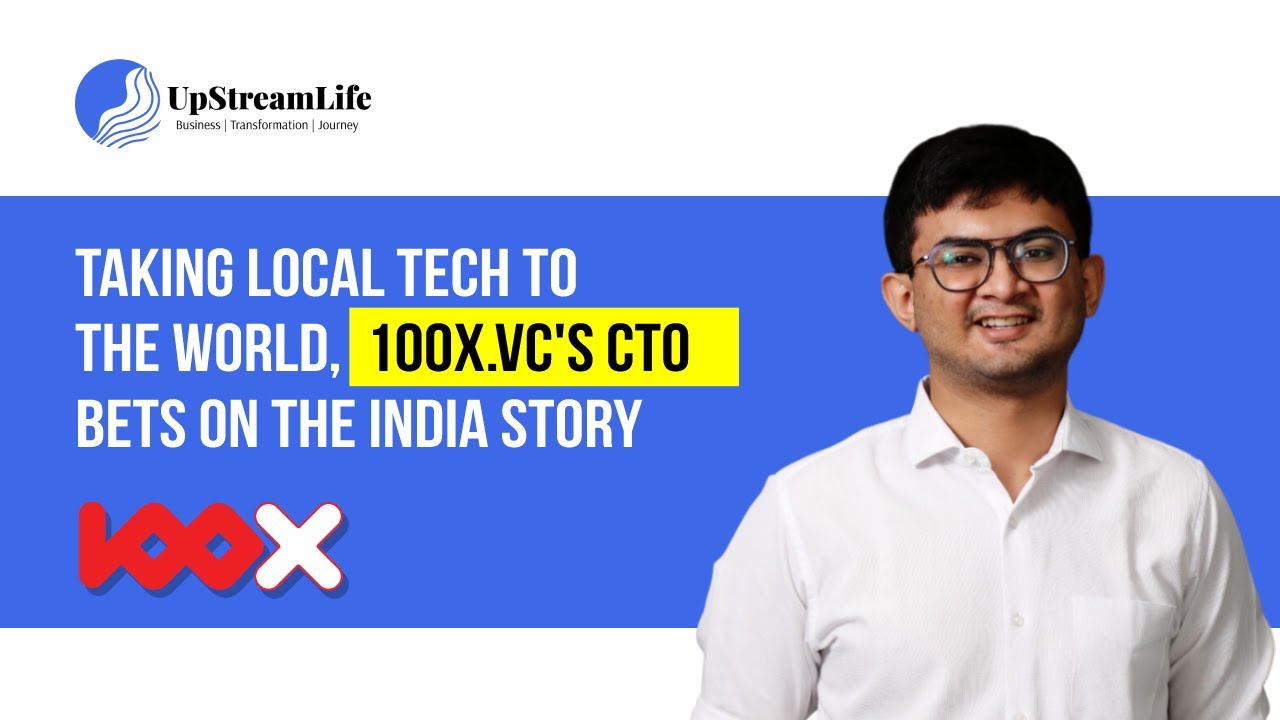
Two years before Shashank Randev moved 100X.VC's instincts a notch up into 247VC, his founding partner and CTO sat down to explain how the engine actually ran underneath. Vatsal Kanakiya, IIT Bombay engineering graduate and one of five people who personally read every single deck of the 20,000 applications a year, walks through the iSAFE mechanics he helped author, the anti-dollar hegemony stance that turns a 25-lakh cheque into a real product budget, why he prefers Toyota's five whys to most founder pitch decks, and the seven-to-eight portfolio companies already at Series A by mid-2023. The conversation is the inside view of the same partnership Episode 11 looks at from the outside.
In sixty seconds.
Vatsal Kanakiya runs the technical side of 100X.VC. By June 2023 the firm has written cheques into 105-plus startups (now more, he corrects on air), seven or eight of them already at pre-Series A or Series A, and the five-person partnership reads every single deck themselves rather than route through analysts. The cheque is the smallest part of the product. The rest is the standardised iSAFE note, the eight-pitch-day cadence, and the internal tooling Vatsal builds to keep filtering 20,000 applications a year without dropping signal.
The substance underneath the operations is more interesting than the operations. Vatsal is an explicit anti-dollar-hegemony believer: he argues that pricing yourself in dollars at pre-seed reprices your own ambition unfavourably as the rupee depreciates, and that a 25-lakh cheque is plenty if a founder thinks in rupees and ships in rupees. He invokes Cartesian skepticism, Socratic questioning and Toyota's five whys as three names for the same first-principles ladder. He is a CBDC believer, a DeFi believer, an Asimov reader, and a Game-of-Thrones-as-Odyssey-reframe partisan.
The companion frame to Episode 11 is unmistakable. Where Shashank narrates the macro arc (the floor, the notch up, the pivot to 247VC), Vatsal narrates the daily mechanics: the form on the website, the yes/no filter every two or three days, the tacit knowledge that resists handoff to junior analysts, the 100X gurukul that trains founders the firm did not even back. The conversation is the engineering decisions behind a thesis that becomes legible only when you read both episodes together.
Where to land in the conversation.
Each chapter opens the YouTube video at that timestamp in a new tab.
The decade Vatsal sketches.
100X.VC's arc through Vatsal's narration, lined up with the regulatory and cultural landmarks that bracket it.
Six ideas to carry into your own work.
Mental models lifted from the conversation that travel beyond venture. Each one is the kind of thing you can quote in a partner meeting on Tuesday.
The market wins, twice out of three.
The internal saying Vatsal recites verbatim. If the market is great and the founder is okay, the market wins. If the market is okay and the founder is great, the market still wins. Only at great and great does magic happen. The point is that 100X.VC's filter starts with the market and not the founder, even though they back founders for life.
The anti-dollar-hegemony stance.
Vatsal's pet argument. Indian founders who price themselves in dollars at pre-seed inherit a depreciation tax they did not earn. To justify a $100 million valuation, when the rupee moves from 70 to 80 to 83, you have to do 800 rupees of revenue where you used to need 700. Think in rupees, raise in rupees, hire in rupees. A 25-lakh cheque is plenty when ambition is denominated correctly.
First principles as three traditions, one ladder.
Vatsal names three lineages for the same move: Cartesian skepticism cutting down to I exist and rebuilding, Socratic questioning asking why-why-why-why-why, Toyota's manufacturing system asking the same five whys on the factory floor. Each axiom is perpendicular to the others, not parallel. The point is to build a multi-dimensional frame, not to win a debate.
Generalists in an open world.
David Epstein's Range, named on air and immediately operationalised. Closed-loop systems like chess reward 10,000-hour specialism. The real world is open-loop, so the founder who has touched manufacturing, retail, code and policy beats the founder with one perfect resume. The CTO who reads Infinite Jest and the founder who knows decentralised finance are the format now, not the exception.
The idea fails, the founder does not.
100X.VC's stated thesis from day one. The portfolio is built around backing founders, not businesses, so when Pravin Kumar's first company Moving did not pan out, the same partnership wrote a second cheque into his next venture, Plug Money. The idea may be wrong, the opportunity may close, the hypothesis may break. The founder is still the same person who learned the lesson the idea cost.
Pop culture permeates philosophy.
Vatsal's read of why first-principles thinking is now showing up in Indian pitch decks. Shark Tank India in this decade is what KBC was in his, a televised vehicle that smuggles a vocabulary into ordinary households. Mental models do not spread through textbooks. They spread through the channel a fifteen-year-old already watches. The 2028 cohort of founders will be the first to be raised entirely on this vocabulary.
Fifteen things to actually walk away with.
Each one carries the timestamps where the moment lives, and a transferable note for work that isn't venture.
Twenty thousand applications, five readers, no analyst layer.
The single most operationally specific moment in the conversation. 100X.VC sees 20,000 startup applications a year, and Vatsal says, plainly, that every single deal is read by the five partners themselves. No analyst pool, no associate screening, no funnel-cutter who has been on the team for under three years. The reason is not ego; it is that the tacit knowledge of recognising hunger, sharp positioning and unusual founder backgrounds has not been transferable to anyone who has not done it for that long.
The internal tooling exists, but it is built deliberately for the parts in between (communications to founders, deal follow-ups, status routing) and not for the judgement call itself. That call stays human, slow, and concentrated. Pre-seed at this volume is a filtering business, and the moat is the filter, not the cheque.
The iSAFE note is preference shares stripped of investor rights.
Vatsal walks through the legal anatomy in two sentences. The iSAFE is fully compliant with Indian law on its own, structured as preference shares that convert only on the first priced round. What the instrument does is strip away every right that pre-seed investors did not need. No board seat. No voting rights. No put option. No drag-along. No tag-along. No rights of first refusal. Liquidation rights are kept at the standard ceiling, a small set of consent matters are kept for governance, and information rights are kept for reporting. Everything else goes away.
The case he makes is severe: a five-lakh writeoff is meaningless to a high-net-worth investor, and any time spent on recovery is time the same investor would have earned more from elsewhere. So why drag a founder through the paperwork. Make the cheque clean, make the conversion mechanical, free the founder to focus on the round that actually matters. The iSAFE is a refusal of investor seniority at the stage where the founder's own room is the scarce resource.
Twenty-five lakhs is enough, if you think in rupees.
Vatsal pushes back on the "25 lakh check is too small" complaint directly. In the first eighty cheques, 100X.VC's playbook was a quarterly pitch day, six-to-nine months of runway, and structured milestones to clear in time to raise follow-on at that pitch day. By his number, eighty to ninety per cent of every batch raised onwards within three months. The cheque size was not the constraint; the founder's accounting unit was.
He runs an exercise in his orientation cohort. He asks a class of forty founders how many have ever spent more than twenty-five lakhs in their life. Maybe two hands. The fundraising aspiration tends to be in dollars because the ecosystem talks dollars, but the spending discipline only develops once founders have first internalised digestion at twenty-five lakhs. Million-dollar rounds without that base build the wrong reflexes early.
The dollar hegemony tax falls on the rupee founder.
The most argumentative passage in the conversation. Vatsal calls himself a "big anti-dollar person" and walks through the arithmetic. A founder valued at $100 million on $10 million of revenue when the rupee is at 70 implicitly owes 700 crores of revenue. At 83, the same valuation now implies 830 crores. The dollar drifted upwards between 2018 and 2023 by nearly thirty per cent, and every rupee-revenue startup that priced in dollars during that window inherited a revenue target the world quietly moved.
His prescription is structural, not patriotic. Price in rupees, raise in rupees, denominate salaries in rupees. Indian SaaS founders who pay engineers in rupees and earn in rupees create more headroom per round than peers who pricetag everything in dollars and then spend in dollars by reflex. He admits the ecosystem incentive is the wrong way; he wants founders to fight it anyway.
Late-stage Indian capital is what opens the gate for Indian-language founders.
Vatsal traces the English-fluency selection effect cleanly. A Series B fund writing a five-million-dollar cheque needs the next round to come from Tiger, SoftBank, KKR or another global pool, and those funds only speak English. So the Series B fund pre-selects English-speaking founders. The Series A fund pre-selects in turn. The bias propagates downward into seed, with the cost ultimately paid by a Kochi or Indore founder whose business is excellent and whose pitch is in Hindi or Malayalam.
The opening he names is the rise of late-stage Indian-LP-backed funds. A91, Sequoia India, Lightspeed and others writing larger rupee cheques means a founder can plausibly run from seed to IPO without a foreign investor in the cap table. Once that path is real, the language constraint dissolves from the top down. Without that path, every effort to "improve English skills" treats a symptom rather than the cause.
The five-factor filter, and why the market always comes first.
Asked what 100X.VC actually looks at, Vatsal answers in a structured way for the first time. There are five things on the website. The first and most important is the market: is it interesting, is it unique, is it cluttered or uncluttered, is it large. The other four (founder, product, business model, traction context) are weighted, but the market gates the conversation. The internal saying (great market and okay founder beats okay market and great founder) is operational rather than philosophical.
The second thing he emphasises is communication. Decks are shallow by construction, so the founder's ability to speak the market clearly, succinctly and in person carries disproportionate weight in the in-person stage. He explicitly tells Vishal he himself was a "quiet, observing" person in 2018, and that crisp communication is a learnable craft, for founders and investors alike.
Sector is not the filter; founder is.
The 105-startup portfolio Vatsal describes spans consumer brands, AI/ML, SaaS, D2C, deep tech, robotics, biomedical devices, and one company called Think Metal that builds a desktop 3D printer for metal parts. Asked which sectors worked and which did not, he refuses the framing. The mindset, he says, is abundance: every sector has investable opportunity if the founder is great and the market is right. The internal posture is to never shut a sector down.
What that means in practice is a directed thesis inside each sector: a specific cut on what makes a deep-tech company venture-backable versus what makes it a research project, what makes a consumer brand defensible versus what makes it a campaign. The sector taxonomy is a routing convenience, not a thesis. The thesis lives one layer down, in the per-sector cut. Vatsal calls this an "abundance" framing on air.
Pravin Kumar, twice: the founder-not-idea bet in practice.
The clearest illustration of 100X.VC's stated thesis. Pravin Kumar was eighteen or nineteen when 100X.VC wrote into his first company, Moving. The startup did not work. He came back to the same partnership with a second company, Plug Money. They wrote the cheque again. The decision rule is named explicitly on air: the idea may fail, the opportunity may not work, the hypothesis may be wrong, but the founder, by that test alone, is not a rogue. Rogues are a different case altogether.
This is the kind of policy that only works at scale if there is no fund-level penalty for double-counting the same person across vintages. The iSAFE structure is permissive enough, the partnership is small enough, and the conviction is concentrated enough in the five readers that the second cheque costs nothing institutional to write. The cost is one analysis. The benefit is a founder who knows the firm has already seen them fail.
Younger founders build from first principles; older founders execute the gap.
Asked how the firm handles a forty-five-plus founder at idea stage, Vatsal draws the cleanest contrast in the conversation. Younger founders, lacking domain experience, tend to think out of the box because they do not yet know which rules exist; they reconstruct from first principles. Older founders bring a different asset: years of watching an industry, recognising where the unsolved pain is, knowing the exact path to the customer, and then executing on that intuition with no romance.
Both are venture-backable. The error younger founders make is to refuse domain learning. The error older founders make is to assume the prior playbook still holds. The firm's posture is that there is no upper or lower age limit, no IIT-versus-non-IIT cut (he notes that sixty to seventy per cent of the portfolio is non-IIT), no gender filter, no background prerequisite. The two thinking modes are complementary inputs to the same investment problem.
First principles, defined: perpendicular axioms, not parallel ones.
The richest theoretical passage of the conversation, and the one most worth slowing down for. Vatsal defines first principles as the act of cutting down to truisms or axioms that are perpendicular to each other rather than parallel. Each one carries an independent axis that the world model has to account for. Parallel axioms are repetitions of the same point in different words. Perpendicular axioms describe genuinely different dimensions of the same problem.
He names three lineages for the same move: Cartesian skepticism reducing all the way to "do I exist," then rebuilding upward; Socratic questioning iterating "why" across an assumption stack; Toyota's manufacturing system asking five whys on the factory floor. Three different centuries, three different traditions, one shared procedure. The synthesis matters: founders who treat first principles as a slogan stop at "be simple." Founders who treat it as a procedure get to actually different decisions.
Tech-first principles also need behaviour-first principles.
Asked whether first principles apply to tech or to business, Vatsal refuses the split. Deep-tech founders need tech-first principles: what is feasible, what is not, where the underlying physics ends. But every product also has behaviour-first principles, because not every product is intuitively usable. Airbnb's whole business was the construction of a new behaviour, letting a stranger sleep in your spare room, that did not exist in 2006. The product had to design the behaviour into existence before it could measure adoption.
The argument is severe for founders who treat product as a feature checklist. Most consumer or workflow products require the buyer to learn a new motion, and the work of teaching that motion is part of the product, not part of the marketing. Deep-tech founders sometimes underweight this; consumer founders sometimes overweight it. The right balance, which Vatsal does not say outright though the conversation implies it, is to budget behaviour-design effort the way you budget engineering effort.
Range, the book, as a posture for an open-world business.
Vatsal recommends David Epstein's Range on air and explains the punchline in his own words. Chess, classical music and golf are closed-loop systems: fixed rules, defined feedback, deterministic reward shape. Inside those systems, ten-thousand-hour specialism wins. The real world is open-loop, and the open-world reward shape favours generalists who can pull on multiple frames. Founders who only know SaaS are at a disadvantage when their SaaS pricing model breaks; founders who have lived in manufacturing, retail, code and policy can route around.
The argument is also a self-portrait. Vatsal is an engineering CTO who reads Asimov's Foundation, David Foster Wallace's Infinite Jest, Madeline Miller's Circe, and a primer on decentralised finance, and treats those inputs as professional inputs rather than hobby reading. The 100X.VC posture toward founders is the same. Hunger is necessary. Range is the multiplier.
The 100X Gurukul: educating founders the firm did not back.
One of the less-publicised parts of the 100X.VC operating model. The firm runs a programme called 100X Gurukul: three months, application-only, open to founders whether or not 100X.VC has invested in them. The content is masterclasses with operators, investors, other VCs and previously-successful founders, both online and offline. The cost to the firm is real; the cost to the founder is time. The pay-off for 100X.VC is a wider top-of-funnel signal and a more legible community downstream.
Vatsal frames it as community investment, but it is also a category-defining play. The firm trains the cohort of founders the firm could not write into, and those founders carry the firm's vocabulary into the next pitch room. The Gurukul is brand work in its purest form, content that works as a selection mechanism and as marketing at the same time.
Shark Tank India is doing what KBC did for general knowledge.
The most underrated cultural read in the conversation. Vatsal argues that the spread of first-principles thinking and MVP iteration vocabulary in Indian founder rooms is a pop-culture function rather than an education-system function. When he was a kid, KBC made general-knowledge accumulation aspirational for a generation of middle-class parents, and an entire cohort developed a reading habit because of a televised quiz show. Shark Tank India is doing the equivalent right now for the language of startups.
He projects the implication forward. The kids who were ten in 2018, raised on smartphones and Shark Tank India, are eighteen in 2028. They are Gen Alpha rather than Gen Z, and their default vocabulary already contains MVP, PMF, runway, valuation cap, and unit economics. The next decade of Indian founders will not have to learn this language as adults; they will have absorbed it as teenagers. The startup ecosystem is, in his framing, in the late stages of a permeation cycle that began around 2010 and matures around 2028.
Circe, Infinite Jest, hyperledger CBDC: the CTO's open booklist.
The final stretch of the conversation is the most personal. Vatsal is currently reading David Foster Wallace's Infinite Jest, a 1996 novel he describes as a book about depression, addiction, and living in post-Nixon American capitalism. He recommends Madeline Miller's Circe as the reimagining of an Odyssey antagonist into a protagonist, especially useful for men learning to empathise across gender. His favourite business book of the year is DeFi and the Future of Finance, a primer on decentralised finance that informs his "very strong thesis" on CBDCs.
The CBDC point is the operational one. He is a public-blockchain believer; he would ideally see central-bank digital currencies built on public chains like the Australian CBDC pilot on Ethereum. India, per his read, is going the hyperledger-fabric direction, a private permissioned chain. He flags the distinction matter-of-factly without picking a fight, but his preference is on the record. A working day that includes IIT-Bombay engineering, fund operations, philosophy reading and DeFi thesis development is the open-world generalist posture, in one person.
What the episode measures.
Every figure below was said on air. Timestamps open the video at the moment it lands.
Twenty thousand decks, five readers
What the iSAFE takes out
The revenue target the rupee moved
The twenty-five-lakh cycle
Lines worth keeping near your desk.
The jargon, unpacked.
Some of these will be obvious; some won't. Skim, mark the unfamiliar, come back later.
Three angles on Monday morning.
If you don't work in venture, here's what to take.
If you're a founder
- Audit the currency your goals are priced in. If you are earning in rupees and pricing valuation in dollars, you are running a depreciation deficit you did not budget for.
- Treat 25 lakhs (or whatever your equivalent first-cheque size is) as a complete budget, not a bridge. Build a six-month roadmap that ships a real product on it, not a runway that buys time to raise.
- Write down your five most important assumptions and check whether they are perpendicular axes or parallel restatements. The duplicates are where you will be wrong first.
- If your product requires a behaviour that does not yet exist, budget design effort for the behaviour the way you budget engineering effort for the feature. Most launch failures are behaviour-design failures.
- Communicate the market clearly. Decks are shallow by construction. The market thesis you can speak in 90 seconds is what carries you through the in-person stage.
If you're an engineer or CTO
- Read outside your stack on purpose. Vatsal is a CTO with a current reading list of Infinite Jest, Circe, Foundation and DeFi primers. The CTOs who hold open-loop posture stay relevant when their stack is disrupted.
- When building internal tooling, automate around the human judgement, not the judgement itself. The right place for ML in your team is the routing, the retrieval, the follow-ups, not the yes/no decision your senior people are paid for.
- If you sell to enterprises, separate "technical diligence" from "technical pattern recognition." They sound similar; the second is judgement and the first is procedure. Most due-diligence conversations are actually the second mislabelled.
- Run the five-whys exercise on your own product roadmap quarterly. If three of the five "becauses" repeat each other, your roadmap is single-axis and a competitor can blindside you.
If you're an investor
- Decide explicitly whether your moat is the cheque or the filter. If the filter, instrument it: document the no's, log the reasons, train the next reader. If the cheque, optimise reserve allocation.
- Standardise paperwork at low value-per-transaction by stripping every clause that does not change behaviour. The iSAFE is the template; copy the principle into whatever stage you write.
- Back founders, not businesses. Make the second cheque to a second-time founder structurally cheaper than the first one was: institutionally, emotionally, in committee time.
- Run a Gurukul. The cheapest way to scale your firm's vocabulary across a market is to teach the market your vocabulary directly. The graduates are your distribution.
The whole conversation, searchable.
Click a timestamp to open YouTube at that moment. Click any line to highlight it (yellow). Highlights and notes save in this browser only.
00:00 in the page to seek.