When the group mediclaim ends, a credit line on tap is the second cover.
India's group mediclaim policy averages three lakh rupees per employee and runs through a thicket of inclusions and exclusions that exist because insurers cannot price every procedure into the premium. Chris George spent his father's hospital admissions discovering where that cover ends. QubeHealth is the product he built on the other side of it: a no-cost credit line, sponsored by the employer for the price of a daily cup of tea, that an employee can swipe at any of twelve thousand clinics for anything the policy did not pay, with the lender financed by an interchange commission rather than interest. The conversation is a tour of why the model became viable after the pandemic, and what it implies about who actually controls healthcare spending in India.
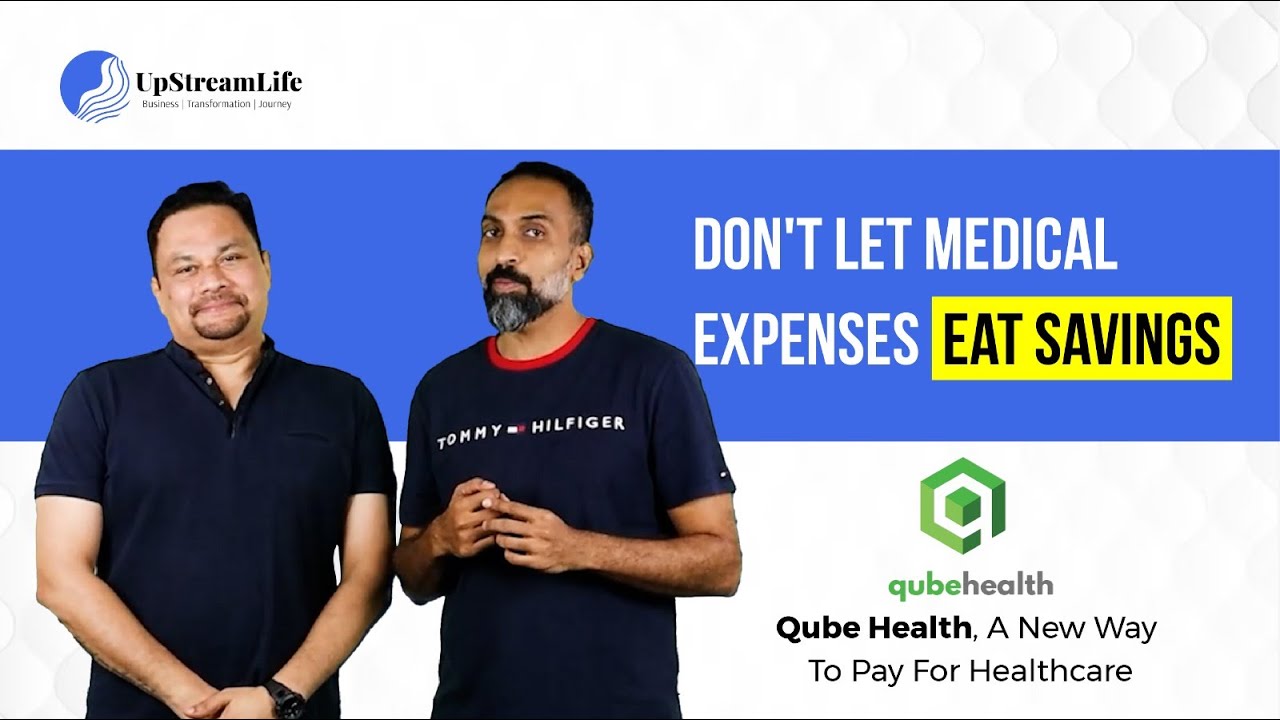
In sixty seconds.
Indian out-of-pocket expenditure on healthcare runs at one of the highest shares in the world because group mediclaim policies stop short of OPD, dental, vision, mental health, fertility, and most preventive spend. The gap is the product. When a teenager needs Invisalign, when the dog needs the vet, when a parent's ICU stay exceeds the two nights the policy covered, the family dips into a credit card or breaks an FD. QubeHealth replaces that with a no-cost EMI credit line, paid for by the employer at roughly seven hundred and twenty rupees a year per employee, that the employee can swipe at any of twelve thousand hospitals, clinics and diagnostic centres on the network.
The model works because Chris George chose not to lend for a spread. QubeHealth makes its money on interchange, a commission paid by the healthcare provider for delivering a cash-up-front customer who would otherwise have deferred care. The employer pays a fixed per-head subscription; the employee pays nothing; the lender pays the merchant fee that any swipe would have paid anyway. The three sides of the marketplace each get a cheaper version of what they were already doing.
The opening line of the conversation is Chris's father's diagnosis. Every founding story under this roof has a hospital admission inside it: Chris's, his co-founder Dhiren's, and a number of the team's. The pandemic was the accelerant: HR conversations went from "this is nice" to "I need it" within six months. Three years in, QubeHealth runs across two hundred and seventy corporate clients with about a quarter of a million subscribers, the bet being that an open-network credit primitive sponsored by employers will outrun the closed-network alternatives the cartelised hospital ecosystem keeps trying to build instead.
Where to land in the conversation.
Each chapter opens the YouTube video at that timestamp in a new tab.
From the policy to the platform.
The arc Chris sketches, lined up with the public-record landmarks that bracket the QubeHealth story.
Six ideas to carry into your own work.
Mental models lifted from the conversation that travel beyond healthcare fintech.
Credit on tap, not credit by event.
The traditional health-finance product is event-triggered: a hospital admission triggers an insurance claim. QubeHealth's primitive is the opposite: a standing credit line that exists before any event, drawable for a vet visit or a hair transplant. The reframe is from policy-as-claim to policy-as-balance. Once the balance exists in the employee's head, the friction at the point of care collapses, and the deferred-care tax that families pay every year disappears with it.
Interchange, not interest.
Most lending businesses make money on the spread between cost of funds and rate of advance. QubeHealth refuses that path. It earns instead from the merchant: a commission the hospital pays because QubeHealth converts a deferred patient into an upfront paying customer. The lender's incentive is now to make the swipe happen, not to maximise the interest book. The borrower has no reason to fear default. The merchant absorbs what they would have paid any card network anyway.
The non-network problem.
Indian health insurance enforces hospital networks by making non-network admissions reimbursement-only: cash up front, claim later. QubeHealth inverts the network: the employee can use the card anywhere there is a POS terminal, on any non-network hospital, and the cashless experience becomes universal. Open network is a feature against insurers who use network closure as their primary lever.
The CHRO emotional, the CFO rational.
Selling into a corporate requires two sales running parallel. The CHRO sale is emotional: the company that cares, the retention narrative, the stress-removal story. The CFO sale is rational: no balance-sheet liability, no salary-hike pressure, no top-up insurance premium. Chris explicitly designs the pitch so each half holds independently. The product survives because neither side has to compromise for the other.
Chindi by design.
Chris's word for QubeHealth's culture is chindi: tightly frugal, intentionally Spartan, structurally allergic to headcount. The phrase he uses is special-ops commandos, paid better than market but kept small in number, in contrast to an army. Frugality works as a hiring filter rather than a cost discipline. Only the few who agree to operate small will join. The market down-cycle, in his read, makes the constraint easier to enforce.
The mandi.
The Hindi word for a marketplace. Chris uses it deliberately. QubeHealth runs a three-sided market: corporates on one side, twelve thousand healthcare providers on the other, and lenders underneath, ready to deploy capital against the credit lines. The mandi-operator's job is to keep all three sides cheaper than what they were doing before.
Sixteen things to actually walk away with.
Each one carries the timestamps where the moment lives, and a transferable note for work that isn't healthcare fintech.
The cover is three lakh. Your parents will need more.
Chris states the national average of group mediclaim cover per employed Indian at three lakh rupees. That cover is supposed to extend to spouse, two children and two parents. Anyone who has been inside an Indian hospital corridor in the last decade understands that three lakh is a deductible, not a policy. India is the diabetes capital of the world; one ICU admission of a parent erodes the cover before any procedural billing begins. The cover is structured to underprice the premium for the corporate, not to actually cover the family.
The wider problem is one of compounded underinsurance. Twenty-five to thirty per cent of Indians have any health insurance at all. Of those, almost everyone is underinsured. Chris's own line, "I don't recall anybody who's come back to me and said the insurance paid for 100 per cent", is the cleanest one-line summary of the Indian health-finance system available.
Inclusions and exclusions are where the policy ends.
The pandemic root-of-awakening, Chris calls it. Employees started calling HR to claim against the group mediclaim they had largely forgotten existed, and ran into the fine print for the first time. ICU is covered, but maybe only two or three nights. Procedure X is covered, procedure Y is not. The policy is written so that the insurer can price the premium, and every exclusion is a place the family becomes a self-payer.
OPD spending, dental, vision, mental health, fertility, pet care, cosmetic dentistry, hair transplant, knee replacement at certain price points, root canal, cataract. All of it sits on the wrong side of the inclusion list. The Indian household, Chris says, spends roughly ten per cent of its monthly budget on healthcare. The insurance company does not see most of it.
Out-of-pocket is sixty-plus per cent. It is the highest in the world.
The total Indian government health spend, Chris reminds Vishal, is around 0.75 per cent of GDP. Most peer economies spend at least five per cent of GDP through public channels. The private sector picks up the slack, but unevenly, fragmented across super-specialty chains, standalone clinics, diagnostic networks, and a pharmacy ecosystem with no consolidated price book. The structural consequence is that the Indian patient pays a larger share of their lifetime medical cost out of pocket than almost anywhere in the developed or developing world.
QubeHealth's wedge is not insurance reform. The system is too fragmented, the spending too distributed across too many small line items, for a single insurance product to ever cover the gap. The credit-line primitive admits that the gap is permanent and finances around it.
The iPhone is on no-cost EMI. The cataract surgery is not.
One of Chris's sharpest framing devices. You can walk into a phone store, swipe a card, convert to three-month no-cost EMI, and leave with an instrument worth a month of household income. The whole consumer-credit infrastructure of Bajaj Finserv, ZestMoney, Snapmint and the bank-issued EMI offers has trained the urban Indian buyer to expect frictionless financing for anything aspirational.
Healthcare has not got there. The cataract patient is asked to pay cash up front. The dental implant is quoted at full retail with no payment plan. The reason isn't credit risk, since the employed patient is creditworthy. It is that no one built the rails. QubeHealth's bet is that the BNPL-for-iPhones expectation has now seeped into the bloodstream of the urban Indian household and is ready to be redirected into healthcare. The card, the POS terminal, the UPI link, the prepaid loaded balance: same mechanics, new merchant category.
The product is interchange, not interest.
Chris is explicit and the line is worth quoting in full. "We don't make money on the lending. We make money when you take my money and go and spend." When the employee swipes the Qube card at a hospital, clinic or diagnostic centre, the merchant pays QubeHealth a commission, not the borrower. The lender is fully repaid by interchange and merchant fees. The credit on the user side is genuinely no-cost.
This decision is foundational. It means QubeHealth is structurally aligned with the merchant network and the employer, not with maximising the credit utilisation of any individual employee. There is no incentive to push a vulnerable user into more borrowing. The interchange model also gives healthcare providers a positive reason to keep accepting the card, because they get a paying customer who would have either negotiated or deferred. Comparatively, a Bajaj Finserv personal-loan rep faces a hospital that has no commercial reason to engage with them.
Seven hundred and twenty rupees per employee per year.
This is the unit. The corporate pays roughly seven hundred and twenty rupees per employee per year for the QubeHealth subscription. Two rupees a day, Chris says, less than the cost of a cup of tea served to the same employee. For that, the employer offers a credit line of up to ten lakh per family with no balance-sheet liability and no actuarial risk.
Compare to the cost of raising the underlying group mediclaim cover, which scales premium superlinearly with sum insured. Compare to the cost of running an internal hardship-loan corpus, which most companies cannot maintain. The arithmetic favours QubeHealth so strongly that the CFO objection collapses to a budgeting question ("I wish you had come a month earlier, I have already allocated this year") rather than a strategic objection. Chris's response is the partnership channel with insurance brokers, who bundle QubeHealth inside the renewal cycle of the underlying policy.
The CHRO sells the company that cares. The CFO sells balance-sheet relief.
Chris's most-repeated tactical insight. The same QubeHealth proposition lands as two different products when pitched to the two roles. To the CHRO, it is the company that cares: a way to look the employee in the eye and say the in-laws and the dog and the parents are all covered, a retention lever that does not show up on the salary spreadsheet, a story the next campus visit gets to tell. To the CFO, it is the elimination of the management-loan request, that awkward conversation in which a long-tenured employee asks for bridge money because their parent is in ICU.
The point of running both narratives in parallel is structural. The buying decision in most Indian companies involves both functions, and they sit in different meetings. A pitch that only carries on the CHRO leg is vulnerable to a CFO veto on premium; a pitch that only carries on the CFO leg gets stuck waiting for HR to operationalise. Run both, and the cycle compresses.
Twelve thousand hospitals, clinics, diagnostic centres. Open network.
The supply-side number. QubeHealth runs on roughly twelve thousand healthcare providers, with the explicit principle that the card works at any POS terminal, network or not. Open network is positioned against the closed-network logic of insurers and the curated-network logic of competitors like MediBuddy and Practo Plus, both of which lock the patient into a narrower path in exchange for a discount or a cashless guarantee.
The Indian patient, Chris keeps returning to, does not pick the closest network hospital. They pick the closest hospital. The product that wins is the one that does not punish the panicked choice in an emergency. Open network is also a structural moat against insurers attempting to bundle their own EMI products; the moment an insurer pushes a closed-network offering, QubeHealth's universality becomes the differentiator.
The card sits on Yes Bank's prepaid rails.
The instrument is, technically, a co-branded prepaid card issued in association with Yes Bank. That choice matters because the RBI's Prepaid Payment Instruments regulations have evolved repeatedly over the QubeHealth window (most consequentially the 2022 circular that disrupted the BNPL-on-card model used by Slice and Uni), and the prepaid-card framework is the regulatory home that survived. Building on Yes Bank's licence gives QubeHealth the issuer permission, the KYC scaffolding, the cashbacks-on-spend mechanic, and the audit trail it needs to run the wallet without becoming a bank itself.
The other rails it supports are UPI (so the same balance can be drawn from the Qube app at a clinic that does not have a card terminal) and the standard POS network anywhere the card is accepted. The product surface is therefore card-and-UPI on the front, and an issuer-and-loan-tap on the back, with the credit line drawn from underlying lender partners against the employer's underwriting signal.
The underwriting signal is the employer's payroll.
QubeHealth does not run a traditional credit bureau pull on every employee. The underwriting collapses into a single signal: the corporate has hired this person, vouched for their tenure, and is paying the per-head subscription. The credit line follows from the employment contract. The product retention is intentionally tied to it: as long as the employee stays with the employer, the line is free for life. If they leave, the line goes with the employer.
This is also where the product is most exposed. A layoff cycle that cuts twenty per cent of a portfolio company's headcount cuts twenty per cent of the active QubeHealth user base attached to that contract. The structural counter is breadth of corporate base and bundle with insurance broker partners, so that the user-loss in any one corporate is absorbed by gain elsewhere. The 270 corporates today, 350-500 in the eighteen-month horizon, is the diversification curve.
The pandemic was when "this is nice" became "I need it".
Pre-March-2020 QubeHealth conversations with HR went well: the product was understood, the value was acknowledged, and the renewal cycle would be approached at leisure. Post-pandemic, the same conversation collapsed in tone. Chris quotes the HR head saying simply "I need it." Three things changed: employees started actually claiming against their group mediclaim and discovering the exclusions, families experienced ICU billing in person, and the management-loan request to HR became an everyday line item rather than an occasional appeal.
QubeHealth's three-year corporate count of 270 is, on Chris's read, a function-of-luck-and-design split. Luck was the demand-side shift the pandemic triggered. Design was that the dual-buyer pitch was already built, so when HR was finally ready to listen, the CFO objection had pre-emptive answers. The lesson is that the product had been in market long enough to be ready when the demand-shift arrived, not that the demand-shift was anticipated.
The mandi has four sides, and Qube runs it.
The clearest articulation of the business model comes when Chris reaches for the Hindi word for marketplace. Corporates pay a subscription on one side. Twelve thousand hospitals, clinics and diagnostic centres run the supply side. Lenders sit underneath, willing to deploy capital against employer-underwritten credit lines. Insurance brokers route the bundle through their existing distribution into the corporate buyer.
What QubeHealth does is operate the mandi: write the rules, settle the transactions, enforce the open-network commitment, and earn the operator's economics. The strategic implication is that none of the sides can vertically integrate the mandi away. An insurer cannot replace the credit line because the regulatory boundary is set elsewhere. A hospital chain cannot operationalise the multi-employer corporate ledger. A lender alone cannot acquire the corporate-distribution layer. The four-sided structure is the moat.
One billion dollars in healthcare credit, three years out.
The most concrete operational claim in the conversation. Over the next three years, Chris says QubeHealth is adamant about activating one billion dollars of healthcare credit: capital available to Indian users at no cost, drawable for any healthcare spend on the open network. The twelve-to-eighteen-month milestone inside that is one thousand crores of credit deployed, across 350 to 500 corporate clients, reaching half a million to a million paid subscribers.
The numbers describe a particular shape of company. Average corporate at ~1,000 employees. Average credit utilisation per active subscriber rising as the product matures. Lender appetite scaling with the demonstrated default rate on payroll-tied credit. The bet is that the demand-side ceiling on healthcare credit in urban-employed India is much higher than the supply-side capacity that exists today, and that running an open-network mandi is the fastest way to discover the actual size of that ceiling.
Ayushman Bharat Digital Mission is the sandbox QubeHealth lives in.
India's National Health Stack (the Ayushman Bharat Digital Mission, ABHA health-IDs, the consent-driven health-records protocol) is the substrate Chris repeatedly invokes when Vishal asks where this all leads. QubeHealth participates in the ABDM sandbox because the long-run product is not the credit line alone; it is the integration of credit, claims, transaction history, and family-level health records into a single dashboard the user can lean on across a thirty-year lifecycle.
The data ambition is unsentimental, and stops short of selling medical records. It is a unification of where a family has spent, so that patterns surface: when did Dad's diabetes management get unaffordable, when did Mum's diagnostics shift, which specialist combinations recur. The argument is that India is the only major economy with both a national digital health stack and a consumer who has already lived through UPI, and therefore the only one where this layer can be built natively.
Five clinics, five different cataract rates.
Chris's single most damning observation about Indian healthcare supply. Walk into five clinics in the same city for the same cataract operation and you will receive five different quotes, each one calculated on local cost structure, local competition, local clientele, and local opaqueness. There is no national price book. There is no consumer-price discovery. The patient pays whatever the clinic decides to charge.
QubeHealth's open-network credit primitive does not solve this directly. But it does collect, over time, the transaction data that makes price discovery possible. The user who has paid for three cataract operations across the family on the Qube card has, in effect, generated a private price book on cataracts. Multiply that across a million subscribers and twelve thousand providers and you have the data layer the existing system has structurally refused to build. That data layer is the structural counter to what Chris calls the cartel: the small set of incumbent provider groups whose interest is in opacity.
Founder schooling: the dot-com crash, Lehman, and No Easy Day.
Chris is on his third venture. First an event-management company started at sixteen before the phrase existed, second a tech-led marketing-services business that grew to four hundred people and was funded by names he chooses not to drop, third QubeHealth. He has lived through two market crashes. His framing on the 2022-23 funding winter is direct: it will find its level, this is the best time to build, the team you hire and the investors you find in a down market are the realistic ones.
The mental model he keeps reaching for is special-ops commando training. The book he names is No Easy Day, Mark Owen's first-person account of the SEAL Team Six operation that killed Osama bin Laden. The line he quotes is "the only easy day was yesterday." On the day-to-day, he keeps a black belt in Taekwondo, trains MMA three days a week when the schedule allows, and reads a book in the bathroom and a book in the car, with Anthony Bourdain's Kitchen Confidential as the favourite non-business read. The composite picture is of an entrepreneur who has built scaffolding outside the business so that the business is not the only thing carrying him.
What the episode measures.
Every figure below was said on air. Timestamps open the video at the moment it lands.
Where the cover stops and the line starts
Who pays for a line that costs the user nothing
The mandi has four sides
Three horizons, in Chris's own numbers
Lines worth keeping near your desk.
The jargon, unpacked.
Some of these will be obvious; some won't. Skim, mark the unfamiliar, come back later.
Three angles on Monday morning.
If you don't run a healthcare-fintech business, here's what to take.
If you're an HR head
- Audit the inclusion-exclusion list of your group mediclaim policy. Quantify how many of last year's hardship-loan requests would have been covered, and how many fell into the gap.
- Map the corporate cost of three things that QubeHealth-type products consolidate: the per-head insurance premium, the management-loan corpus you carry on the balance sheet, and the salary-hike pressure that compounds when an employee dips into emergency credit.
- If you sit in front of a credit-line vendor, ask one question first: who pays for the credit, and who pays for the default risk. The answer tells you whether the product is durable.
- Renew the insurance broker conversation with the bundle in mind. If the broker can route a credit-line product inside the policy renewal, the procurement cycle is one quarter rather than two.
If you're a founder
- Look at the inclusion list of every contract your customers hold today. The biggest unmet markets sit in the explicit exclusions of the dominant incumbent's policy, not in the gaps the incumbent forgot to write down.
- Choose your revenue model with care for which side of the table it puts you on. Lending-spread businesses are aligned with the borrower's continued borrowing; interchange businesses are aligned with the merchant's volume; subscription businesses are aligned with neither and need to find a third axis.
- If your product needs two buyers in the room (CHRO and CFO, sales and operations, founder and CTO), write two pitches in parallel. Don't expect one to carry the other's objection.
- State your unit price against an incidental in the buyer's own budget. "Less than a cup of tea per employee per day" is more powerful than any rupee figure, even when it is the same rupee figure.
If you're an operator running a startup
- Document the cultural words your team uses to describe its own constraints. Chindi, special-ops, commando: the vocabulary is the hiring filter. Make it visible to candidates on the way in.
- Pick the regulatory regime that survives the next reform cycle, not the one that matches your launch month. RBI Prepaid Payment Instruments survived the 2022 BNPL clampdown; closed-loop merchant credit did not. Read the regulator's last circular, not their first.
- Build your routines outside the company before the company is the only thing carrying you. Martial arts, reading, podcasts: the scaffolding decides what you can absorb when the company hits a quarter that doesn't go.
- Run the diversification curve on whatever single-signal underwriting you use. If you depend on one corporate, one channel, one regulator, one lender, write down the number of months of operating runway each single failure costs you, and price the diversification work against that.
The whole conversation, searchable.
Click a timestamp to open YouTube at that moment. Click any line to highlight it (yellow). Highlights and notes save in this browser only.
00:00 in the page to seek.