Episode 95 · Enterprise · 47 min

No one downloads a second app

Boni built a discovery app for India's local shops and found that neither the shopkeepers nor their customers would install it. So it moved the entire product into WhatsApp — catalogues, invoices, inventory, lead bots — where a plain-vanilla setup goes live in five minutes with no integration. The founder walked out of the RBI to build it.

KJ
Karan Javaji
Founder, Boni · with Vishal Krishna
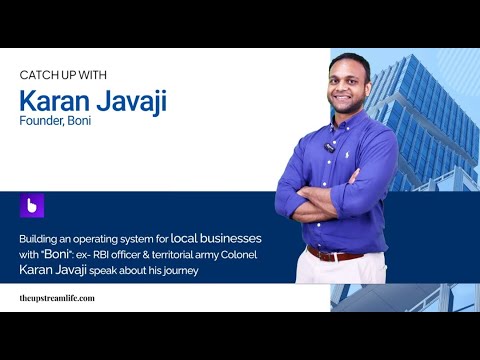
No one downloads a second app — episode thumbnail
47:07
Said in this episode
▶ 24:16
60 mn
Small businesses in India
Vishal's figure on air for the SMB base ONDC is meant to bring online so they can compete with the Walmarts and Amazons; Javaji does not dispute it.
▶ 19:39
5 min
Time to go live, plain vanilla
The base product needs no configuration or integration; connecting it to an existing CRM or ERP is optional work Boni has done case by case.
▶ 15:06
~2 months
Age of the flagship product in market
The conversation-management platform had been out for 'hardly a month and a half or two' at recording — the response quoted here is early, not proven at scale.
▶ 5:47
3 years
Boni's age at recording
Framed by the host and accepted by Javaji; the company began as an MVP built for small businesses in Mumbai just before COVID hit.
▶ 30:37
1 Saturday
Time to build the lead-qualifying bot
A founder with no engineering background built a WhatsApp bot that qualifies inbound leads in a single day, using off-the-shelf language models.
▶ 44:20
100 years
The wall almost no company clears
From the book he had just picked up: hardly any firms in industrial history survive a century, barely any two — evidence that companies are built to last but not to adapt.
The brief

The argument in sixty seconds

Javaji's claim is that software for India's smallest businesses fails on distribution long before it fails on features: Boni's first product, a two-sided discovery app for local shops, died because neither the shopkeeper nor the customer wanted another icon on an already crowded phone. The fix was to stop asking. Boni rebuilt everything on top of WhatsApp — catalogues, orders, invoices, a stripped-down inventory tool the team refuses to call an ERP because the word has 'enterprise' inside it — and treats the messenger as the UI layer over whatever software a business already runs. The product now selling started life as an internal dashboard: Boni built a conversation-management platform to watch its own WhatsApp threads, and customers asked to buy it. Its differentiator is directional. The market solves one-to-many — one business number, many agents behind it. Boni solves many-to-one: ten or twenty salespeople's numbers pulled into a single window, so that when a real-estate rep resigns, the year of customer context sitting on their handset does not leave with them. Alongside that runs an ONDC bet, where the barrier Javaji names is not commerce but compliance — he wants a seller to go live by uploading a catalogue over WhatsApp. And underneath it, a deliberate refusal to raise: bootstrapped, a Karnataka Elevate grant, a little angel money, and what he calls default survival mode, because outside capital buys metrics pressure at exactly the moment a three-year-old company still needs the freedom to be wrong.

Worth your time if you are

Founders about to ask an SMB to install an app
Sales leaders losing customer context to attrition
Operators sizing up ONDC as a distribution channel
Bootstrappers deciding whether to raise at all
Government professionals eyeing the exit to a startup
Episode map

Where the conversation travels

Every block is a chapter, coloured by what it's about. Click any of it to jump straight to that minute on YouTube.

01Cold open: what a boni is 0:00 Vishal introduces a founder who has been an RBI officer, a territorial army man, a horse trainer and a Karnataka rugby player, and Boni pitches itself in one line — digital infrastructure for local businesses, delivered through a WhatsApp layer. 02Cornell, IIM-B, the RBI, then an MVP 1:46 A double major in economics and government at Cornell led to social entrepreneurship, a public-policy research stint at IIM Bangalore and then the RBI, where a founder with no tech background got his first exposure to fintech and to the credit gap in the informal sector. 03The name, and why discovery didn't pay 4:47 Boni — the first sale of the day, a word that Kannada, Telugu, Hindi, Bengali and Marathi speakers each assume is their own — began as a two-sided discovery app, until catalogues proved unscalable and neither shops nor customers would install anything. 04The internal tool that became the product 8:20 Boni built a conversation-management platform to monitor its own WhatsApp threads, discovered other businesses wanted it, and paired it with a deliberately un-named ERP so that an invoice or a lead can be created by typing into a chat window. 05Many-to-one, and the sales-churn problem 12:25 The market already routes one number to many agents; Boni's bet is the reverse — twenty real-estate reps' numbers on one dashboard, permanent conversation history even after deletion, keyword-based routing, and a strong recommendation that companies issue business numbers. 06Dealerships, furniture leads, five-minute setup 17:10 A car purchase conducted entirely over a sales rep's WhatsApp becomes the argument for bot-qualified leads — the same problem a furniture company had, where volume was never the issue — and the plain-vanilla product runs in five minutes without touching an existing CRM. 07Say WhatsApp and people lean in 20:40 Javaji argues the market is fragmented only because its customers are, that saying WhatsApp on a cold call buys instant attention where saying ERP does not, and that Boni stays agnostic to whether the businesses it serves sell B2B or B2C. 08ONDC explained, and the Beckn root 22:55 The open network unbundles the marketplace — sellers list on one app, buyers browse on another, and the two interoperate — with ONDC and Bengaluru's auto-hailing app riding the same underlying protocol, one abstracted for commerce, the other for mobility. 09Selling on ONDC from your WhatsApp 25:20 For a small team the network is a way to own one side of the equation and stop paying for customer acquisition, so Boni is building seller-side infrastructure whose promise is that onboarding means typing into WhatsApp and uploading a catalogue. 10Search anything; a bot in a day 28:00 An early WhatsApp search experiment showed people will type anything into a chat box, intent-heavy queries are where a language model earns its place, and a founder who is not an engineer built a lead-qualifying bot over a single Saturday. 11Default survival beats the fundraise 31:25 Bootstrapped money, a government grant and some angel cheques have kept Boni out of a priced round, and Javaji frames that as strategy — raise to accelerate something proven, not to buy time to experiment under metrics pressure. 12Free delivery, UPI, tier-three aspiration 33:15 Why this decade favours builders in India: a young population, a regulatory framework he calls just right, UPI-grade rails, a wife newly arrived from the US astonished that delivery is free, and tier-two and tier-three towns full of aspiration. 13Why he walked out of the RBI 35:45 One of the youngest people to get there, present when UPI launched, and he left anyway — not for the glamour of startups but because the best job he could have hoped for had started to feel like a job, and institutionalisation was setting in. 14Polo, rugby, and what horses teach 38:30 Show jumping, the Cornell polo team, rugby for Karnataka and three months a year unplugged with the territorial army feed one lesson: riding is two minds working in synergy, where a horse reads fear instantly and influence travels through the smallest shift of posture. 15Scholarships, a famous cat, the living company 42:10 He dismantles the assumption of privilege — Cornell on a scholarship, a horse kept on open land where feed is the real cost — before closing on a book about why almost no company survives a century, and the tribesman who saw only the banana cart because he had never seen a wheel.
Takeaways

Ideas to carry out of this hour

01

The app was the wrong ask, not the wrong idea

Boni's original thesis was sound: a local shop wants people to know not just where it is but what it stocks and at what price. The execution broke on two walls at once — catalogues could not be collected at scale, and neither the shopkeeper nor the shopper wanted another icon on a phone that already has too many. The lesson Javaji draws is that for micro-businesses distribution is the product decision, and the only surface with guaranteed installs was WhatsApp.

02

The dashboard they built for themselves became the business

Revenue was not coming from the consumer-facing apps, because discovery is a nice-to-have for a business that small. Meanwhile Boni had built itself a conversation-management platform simply to watch what was happening across the WhatsApp threads it was running, and other businesses — mid-sized ones with turnover, not street vendors — asked for it. The commercial product is the internal tool, which is why Javaji describes the pivot as something they stumbled into rather than planned.

03

The rep's handset is the real CRM, and it walks out the door

Existing WhatsApp tooling solves one-to-many — a single business number with inquiries fanned out to a support team. Boni's wedge is many-to-one: ten or twenty salespeople's numbers pulled under one dashboard. The failure it fixes is specific to high-churn sectors like real estate, where a rep leaves and every quotation, document and half-finished negotiation on their chat history vanishes with them, even when the SIM belonged to the company; on the platform, the history survives deletion and a colleague can pick up the thread.

04

ONDC lets a small team own one side of the marketplace

Boni's original problem was the marketplace bootstrap: onboard the shop, digitise its catalogue, then go find the customers who want it. An open network splits that in two, because buyers can arrive from any buyer app on the network. Javaji's read is that Boni can now concentrate on being excellent at the seller side and stop treating customer acquisition cost as its own burden — a structural argument for open protocols rather than an ideological one.

05

The barrier to ONDC is compliance, not commerce

Javaji is blunt that the hard part of putting a small seller on the network is the paperwork of getting them registered, not the trade itself. Boni is building seller-app infrastructure whose entire promise is absorbing that complexity, so the merchant experience collapses to opening WhatsApp, saying they want to sell, and uploading a catalogue. Retail is live on the network; automobiles are not yet, which shapes which of Boni's verticals can use it today.

06

Default survival mode is a product strategy, not thrift

Three years in, Boni has run on bootstrapped money, a Karnataka Elevate grant and some angel capital, and has not gone out to raise. The reasoning is not aversion to venture capital but sequencing: a company still hunting product-market fit needs the liberty to try things that do not work, and that liberty disappears the moment there are metrics to meet. Funding, in his framing, is for pushing the pedal on something already proven.

07

An economist shipped a language-model bot in a Saturday

Simple search needs no model — you match the query against your own database. Intent-laden queries like wanting a site nearby do, and that is where Boni puts a language model: extract the intent, then hit the database. The proof point Javaji offers is himself. With no tech background, he spent one Saturday building a WhatsApp bot that does nothing but qualify leads through conversation before a human takes over, and his conclusion is that the model layer is now commoditised enough that occasional fine-tuning is the only real work.

The numbers, drawn

What the episode measures

Every figure below was said on air — timestamps included, caveats kept.

Conversation share

portion of the hour spent on each theme
SaaS & enterprise · 24%Founder journey · 17%Product strategy · 14%Data & digitisation · 11%Sales, GTM & growth · 10%India macro · 8%
SaaS & enterprise24%
Founder journey17%
Product strategy14%
Data & digitisation11%
Sales, GTM & growth10%
India macro8%
Computed from the chapter map of this episode.
Worth keeping

Lines that stay

It was the best job one could have hoped for, but at the end of the day it felt like a job. I was starting to get institutionalised, getting into a comfort zone, losing whatever drive you have — and if I'd stuck on a little longer, I may not even have wanted to leave.

— Karan Javaji ▶ 37:06

Think of WhatsApp as the UI layer for a business. You have your accounting tool, maybe an ERP — what if WhatsApp were the way you interacted with that software?

— Karan Javaji ▶ 11:08

Our focus has been to stay in default survival mode. Let's not depend on funding for survival — if we do raise, it should be to accelerate, not to buy time to figure out what works.

— Karan Javaji ▶ 32:18

In any other sport it's one mind. In horse riding it's two minds that have to work synergistically — horses read nervousness very quickly, so you have to project the confidence that makes them trust you.

— Karan Javaji ▶ 40:32

They showed him the skyscrapers and all he could talk about was the cart the bananas were piled on — because he had never seen a wheel. He was blind to everything else, because that was not his lived experience.

— Karan Javaji ▶ 46:14
Clips that travel

Short on time? Start here

Founders about to ask an SMB to install an app

The pivot: nobody wanted another app

The cleanest three minutes in the episode: why catalogues don't scale, why both sides refused the download, and how WhatsApp became the surface by elimination.

6:40 → 9:20 · 3 min ▶ Watch clip
Sales leaders losing customer context to attrition

When your best rep takes the customers with them

One-to-many versus many-to-one explained through a real-estate team of twenty, and what actually disappears the day a salesperson resigns.

12:25 → 15:20 · 3 min ▶ Watch clip
Operators sizing up ONDC as a distribution channel

ONDC in plain English

Buyer apps, seller apps, the shared protocol underneath, and the specific reason an open network lowers a small company's customer acquisition cost.

22:56 → 26:00 · 3 min ▶ Watch clip
Non-technical founders wondering what AI actually costs them

A bot built in a day by a non-engineer

Where a language model earns its place versus plain database search, and the Saturday-long build that makes the commoditisation argument concrete.

28:32 → 31:25 · 3 min ▶ Watch clip
Government professionals eyeing the exit to a startup

Why he walked out of the RBI

Not a startup-glamour story: the honest account of a dream job that started to feel like one, told without disowning the institution.

35:45 → 38:38 · 3 min ▶ Watch clip
Glossary

The jargon, unpacked

ONDC
The Open Network for Digital Commerce — an Indian government-backed network where sellers list on one app and buyers browse on another, and the two interoperate, so a shop is not locked into a single marketplace.
Beckn protocol
The underlying open protocol that lets those apps talk to each other; ONDC abstracts it for e-commerce, while Bengaluru's community auto-hailing app applies the same base protocol to mobility.
Conversation management platform (CMP)
Boni's core product: software that connects a business's WhatsApp numbers to a shared dashboard so every customer conversation is logged, searchable, routable and permanent even if a message is deleted.
Many-to-one messaging
Pulling many individual staff phone numbers into a single view — the inverse of the standard setup where one business number is fanned out to many agents, and the gap Javaji says the market had left open.
WhatsApp Business API
Meta's paid programmatic channel for companies to send and receive WhatsApp messages at scale; Boni plugs into it for larger clients but also builds tools that work on an ordinary WhatsApp account.
Elevate grant
A Karnataka government startup funding programme; winning it gave Boni non-dilutive money that sustained the company through the years before revenue.
Default survival mode
Running a company so that its existence never depends on the next funding round — closely related to 'default alive', and Javaji's stated reason for not raising a priced round yet.
Connections

If this resonated, go here next

Full transcript

The whole conversation, searchable

184 segments

Auto-generated captions, lightly cleaned. Click a timestamp to open that moment on YouTube.