Episode 25 · Deep tech · 52 min

Two Kinds of Computers

The engineer behind four decades of landmark silicon says the CPU-versus-GPU debate is over: soon there will be AI computers and deterministic computers, collaborating like cortices in one brain. Tenstorrent's bet — a graph-shaped data-flow chip and a clean-slate RISC-V team in India — aims at the 80% of world compute Keller says goes AI within ten years.

JK
Jim Keller
CTO & President, Tenstorrent · with Vishal Krishna
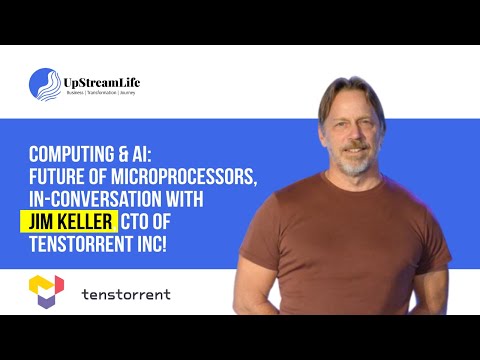
Two Kinds of Computers — episode thumbnail
51:38
Said in this episode
▶ 41:02
80%
World compute that goes AI
Keller is 'very convinced' 80% of the world's computing will be AI in less than ten years.
▶ 17:12
10%/yr
The compound that becomes night-and-day
A 10% faster computer is unnoticeable in any one year but compounds over ten into twice the speed, half the size or twice the battery life.
▶ 41:50
30 → 4–5
Graphics startups after consolidation
At one point there were 30-odd graphics startups; the field reduced to four or five — the precedent Keller applies to today's ~50 AI chip companies.
▶ 35:28
130 → 7 nm
What lithography learned to write
Optical lithography at 130 nm got down to writing 7 nm transistors before the switch to 13.5 nm EUV light — with roughly a 100x density runway still on silicon.
▶ 29:25
10,000
Intel team size — 'a medium-sized city'
At Intel his team was about 10,000 people — a village needing roads and plumbing, versus the startup that aims like a bullet.
▶ 4:24
10×
His DEC timing verifier vs the incumbent
At DEC he and a colleague rewrote the timing verifier that sets chip frequency to be ten times faster and far simpler to use — learning architecture by doing.
The brief

The argument in sixty seconds

Keller's claim is that the CPU-GPU-accelerator taxonomy is collapsing into something sharper: AI computers, trained on data, and deterministic computers that run human-written code, collaborating the way a cerebral cortex works with a motor cortex. A neural network is computation organised as a graph, so Tenstorrent lays that graph across arrays of processing elements and lets data flow through — several times more efficient than a GPU, he argues, once the compiler makes new PyTorch models fast by default. Around the thesis sit his operating rules: Moore's Law is fine at TSMC; ten per cent a year compounds into night-and-day over a decade; build winning products, not novel papers; ten thousand people is a city and a startup is a bullet. He is convinced eighty per cent of computing goes AI within ten years — and Tenstorrent's new India office, designing a clean-slate RISC-V CPU, is hired for that bet.

Worth your time if you are

Semiconductor and systems engineers
Deep-tech founders making architecture bets
Engineering leaders scaling teams
Students plotting a first job in hardware
Episode map

Where the conversation travels

Every block is a chapter, coloured by what it's about. Click any of it to jump straight to that minute on YouTube.

01Cold open: from Harris to 14 years at DEC 0:00 Vishal introduces the fabless AI-chip company, then Keller retraces surfing into Harris, reading the VAX 11/780 manual en route to his DEC interview, 14 years of learning computer design by building tools, and why weekends exist. 02Computers are always a little too slow 6:12 Six decades of progress haven't changed the designer's experience — computation times transistors stays roughly constant because humans tolerate two-week jobs and dismiss sub-second ones. 03Two kinds of computers 8:18 Keller's thesis: AI computers trained on data and deterministic computers running human-written code will collaborate like cortices in one brain — and neural networks now model physics no equation describes. 04Why AIs will probably dream 12:09 Dreaming as the brain's nightly reorganisation — where Keller says almost all his good ideas arrive — suggests AI systems will get a dream mode that replays and restructures what they know. 05Moore's Law is fine; 10% a year compounds 14:55 Against the lock-it-for-seven-years business instinct, Keller says TSMC is still on the curve, consoles show five-year platforms work, 10% a year becomes night-and-day in a decade, and automotive is one iPhone moment from a scramble. 06Software 2.0 meets the data-flow machine 19:30 Karpathy's Software 2.0 becomes Tenstorrent's compiler problem: PyTorch models lowered to graphs laid across processor arrays, several times more efficient than CPUs or GPUs — once new models hit peak performance by default. 07India: from support teams to ownership 22:46 A decade of returning talent turned India's engineering offices into teams that own things; Tenstorrent has incorporated, taken its first ten accepts, and is handing them a clean-slate, verifiable RISC-V CPU. 08Run to win: products over papers 27:00 Papers select for novelty and products for winning — watch a hundred non-competing runners and you can only admire form, but in a race you know who won. 09Villages, bullets, and people problems 29:25 Intel's 10,000-person team is a medium-sized city that needs roads and plumbing, a startup aims like a bullet, and his father's law says technical problems get solved while people problems go on forever. 10EUV physics and the quantum reality check 34:22 Silicon keeps absorbing new atoms from the periodic table — 13.5 nm EUV light writing 7 nm transistors with a ~100x density runway — while photonics stays perpetually five years out and quantum has more media than use. 11The third hype cycle and the 50-chip race 38:30 GPT-3 is too expensive for a billion daily users and self-driving has gone sideways for five years, yet Keller is convinced 80% of computing goes AI within ten — with ~50 chip startups facing graphics-style consolidation, not winner-take-all. 12Basics, books, and Led Zeppelin row 25 44:13 Keller's advice — master basics, join a team that's going fast — gives way to Joscha Bach via Lex Fridman, Feyerabend's Against Method, the improbability of empire, and Led Zeppelin from the 25th row before a Bengaluru farewell.
Takeaways

Ideas to carry out of this hour

01

Two kinds of computers, and the line is sharp

The CPU/GPU/accelerator taxonomy is collapsing into AI computers — trained on data — and deterministic computers that run human-written C, Java or browser code. They will collaborate the way a cerebral cortex works with a motor cortex: an AI deciding to find a path or control something, then calling a deterministic program the way a thought instructs muscles. Keller insists the dividing line is sharp because the workloads, and the right circuits for them, are fundamentally different.

02

A neural network is a model without an equation

Classical science went data, then theory, then equation — E=mc², the index of refraction. A neural network goes straight from a large amount of data to a model that predicts what the system will do, with no equation in between. That makes very complicated, subtle phenomena tractable where a closed-form equation may not even exist — the basis of his claim that networks can understand physics better than the classical pipeline.

03

Technology is compound growth: 10% a year, ten years

The business instinct is to lock a chip platform for seven or eight years, and consoles really do hold for five — getting cheaper while games improve on fixed hardware. But technology developers take a small step every year: 10% faster is unnoticeable in any one year and night-and-day over ten — twice as fast, half the size, twice the battery life. Meanwhile TSMC keeps delivering whatever the Moore's-Law obituaries say, so the out-of-date platform eventually meets its iPhone moment, as automotive will.

04

Lay the graph on the chip: Tenstorrent's bet

An AI program is a large computation organised as a graph with data flowing through it, so Tenstorrent builds a data-flow computer that lays the graph across arrays of processing elements — several times more efficient than a CPU or GPU, he argues, and several times better than competition on price and efficiency. The harder half is the compiler: GPUs only hit peak on models that armies of engineers have hand-optimised with low-level libraries, while Tenstorrent wants a brand-new PyTorch model to reach good performance straight away. They have rewritten that compiler several times, learning each pass.

05

80% goes AI — through a graphics-style funnel

Keller is 'very convinced' 80% of the world's computing will be AI in under ten years, even while calling this the third AI hype cycle: GPT-3-class models are too expensive to serve a billion people daily, and ten autonomous-driving startups have gone sideways for five years. The endgame follows graphics — 30-odd startups consolidated to four or five — so today's roughly fifty AI chip companies face the same funnel. But it is not winner-take-all: applications are diverse, Google keeps the TPU in-house despite it being one of the best AI platforms on the planet, and how AI software should be written is still unsolved, which keeps the market open.

06

India's clean-slate RISC-V is a talent thesis

Keller traces Indian engineering's last decade: a huge return of experienced people, and local teams graduating from support work to genuinely owning things — he watched it happen inside AMD's and Intel's large India teams. Tenstorrent is opening an engineering office, deliberately not a sales office, with about ten accepts already in, and handing the team a from-scratch RISC-V CPU architected to be verifiable and modular using modern software techniques. His pitch to young engineers: at some point you need a clean piece of paper and original design you did yourself.

07

Move technical and people problems along together

His father's law: technical problems you solve, people problems go on forever. Frank Zappa preferred the synthesizer because it doesn't make mistakes — but you cannot build a large technical company with one person. The job is to meet people where they are without letting personal-problem work dominate the technical mandate; engineers who refuse people problems can't scale to a hundred, and managers who do nothing else never ship.

The numbers, drawn

What the episode measures

Every figure below was said on air — timestamps included, caveats kept.

Conversation share

portion of the hour spent on each theme
Deep tech & hardware · 32%AI & machine learning · 26%Leadership & org · 12%Hiring & talent · 10%Product strategy · 10%GCCs & services · 6%
Deep tech & hardware32%
AI & machine learning26%
Leadership & org12%
Hiring & talent10%
Product strategy10%
GCCs & services6%
Computed from the chapter map of this episode.

Chip booms end in consolidation

companies
Graphics startups, p30Graphics survivors5Network-processor st50Network-processor su10AI chip startups, 2050
As stated in conversation — '30-odd' graphics startups fell to 'four or five'; ~50 network-processor startups to 'five to ten'; ~50 AI chip companies face the same funnel.▶ 41:50

The scales lithography learned to write

nm
Old optical lithogra130EUV light wavelength13.5Transistors written7
Keller's lithography arc as stated in conversation: 130 nm optics wrote 7 nm transistors via tricks ~10x smaller than the light itself; 13.5 nm EUV continues the shrink.▶ 35:12
Worth keeping

Lines that stay

Pretty soon there's going to be two kinds of computers: there's AI computers and deterministic computers.

— Jim Keller ▶ 8:36

If your computer was 10% faster you wouldn't notice. But 10% for 10 years could be night and day — twice as fast, half the size, twice the battery life. Technology is about compound growth.

— Jim Keller ▶ 17:12

There's two kinds of problems in the world: technical problems and people problems. Technical problems you solve, and people problems go on forever.

— Jim Keller, quoting his father ▶ 32:38

Quantum computing has been in the news for longer than it's been useful — it's gotten more media than use.

— Jim Keller ▶ 38:30
Clips that travel

Short on time? Start here

Deep-tech founders making architecture bets

Two kinds of computers, sharply divided

The episode's core thesis: AI vs deterministic machines, the brain analogy, and physics modelled without equations.

8:18 → 12:09 · 4 min ▶ Watch clip
Product leaders setting multi-year roadmaps

Moore's Law, consoles, and 10% compounded

Why platforms hold five years while technology compounds 10% a year — ending in the iPhone warning for carmakers.

14:55 → 19:30 · 5 min ▶ Watch clip
Students plotting a first job in hardware

Why Tenstorrent India gets a clean sheet

India's shift from support work to ownership, ten accepts in, and a from-scratch RISC-V CPU as the draw.

22:30 → 27:00 · 4 min ▶ Watch clip
Engineering leaders scaling teams

Products beat papers; villages vs bullets

Run to win the race, not for form — then Intel's 10,000-person city, the startup bullet, and the three kinds of people on teams.

27:00 → 32:24 · 5 min ▶ Watch clip
Investors sizing the AI compute market

The third hype cycle and the 80% claim

GPT-3 economics, self-driving going sideways, 80% of compute going AI, and why ~50 chip startups face a funnel.

38:30 → 44:13 · 6 min ▶ Watch clip
Glossary

The jargon, unpacked

RISC-V
An open-standard, licence-free instruction-set architecture — the base for the clean-slate CPU Tenstorrent's new India team is designing from scratch.
Data-flow computer
A chip where the program's graph is laid out across processing elements and data flows through the layout as the execution — Tenstorrent's architecture, versus fetching instructions sequentially on a CPU or GPU.
Software 2.0
Andrej Karpathy's term for programs created by training a network on data rather than hand-writing code (Software 1.0). Keller expects a 3.0 that nobody has defined yet.
EUV lithography
Chip printing with 13.5 nm extreme-ultraviolet light, succeeding the 130 nm optical era whose tricks were already writing 7 nm transistors — features ~10x smaller than the light used.
Fabless
A chip company that designs silicon but contracts the manufacturing to a foundry — Tenstorrent's model: design the AI chip and software, have a fab make the hardware.
TPU
Google's in-house Tensor Processing Unit — in Keller's words one of the best AI platforms on the planet, but never sold externally, which keeps the merchant AI-chip market open.
Connections

If this resonated, go here next

Full transcript

The whole conversation, searchable

203 segments

Auto-generated captions, lightly cleaned. Click a timestamp to open that moment on YouTube.